04.11.2025 10:30 bis 04.11.2025 15:00
The power of the Sun
Looking at the Sun and its Significance for Our Planet
The sun is vital for life on Earth. Without it, our planet would be dark, frozen, and lifeless.
It is a gigantic ball of hot plasma. Inside, nuclear fusion processes take place: two atomic nuclei merge to form a new nucleus. When hydrogen fuses into helium, an enormous amount of energy is released. The more helium that is produced, the brighter and warmer the Sun shines.
Compared to Earth, our Sun is huge – but in relation to other stars, it is actually rather small. If it were hollow, about one million Earths could fit inside. With a mass of 1,989,000,000,000,000,000,000,000,000,000 kg, it accounts for 99.86% of the total mass of our solar system. To visualize this in class, we use a blue push pin to represent Earth and a yellow foam ball to represent the Sun. The to-scale distance between them would be about ten meters in the classroom.
The Sun moves around the center of the Milky Way, while the Earth orbits the Sun. The Earth’s rotation and the tilt of its axis cause day and night, as well as the seasons. Sunlight takes 8 minutes and 20 seconds to reach us. Heat, however, cannot be transferred directly across this distance – it is only generated on Earth when light is absorbed and converted into thermal energy.
The Sun as the Source of Almost All Energy
Virtually all forms of energy on our planet originate from the Sun: Without the Sun, there would be no photosynthesis, no plant growth, no biomass, no wood, no coal, no oil, and no natural gas. Even wind and hydropower exist thanks to solar energy: without sunlight, there would be no evaporation, no water cycle, and no air movement.
Warm air rises (creating thermals and low pressure), while cool air sinks (heating up and forming high pressure). The uneven heating of different – such as rock, water, or forest – and their varying heat capacities cause air currents, including sea and land breezes.
Experiments and Discoveries
What happens on Earth when the Sun shines? Using a tree trunk with annual rings, we explore the concept of photosynthesis. We model the water cycle with a transparent bag containing a little water, warmed by sunlight. We demonstrate the formation of wind with a tealight and a small pinwheel. Afterwards, we transfer these three phenomena onto a worksheet and match them with their corresponding energy sources.
The Sun’s power is impressive: In Switzerland, solar radiation at noon under direct sunlight reaches about 1,000 W/m². Over a year, the Sun provides roughly as much energy per square meter as 100 kg of heating oil. Overall, the amount of energy the Sun emits to Earth is more than 5,000 times greater than humanity’s total energy demand. It is therefore up to us to make better use of this energy.
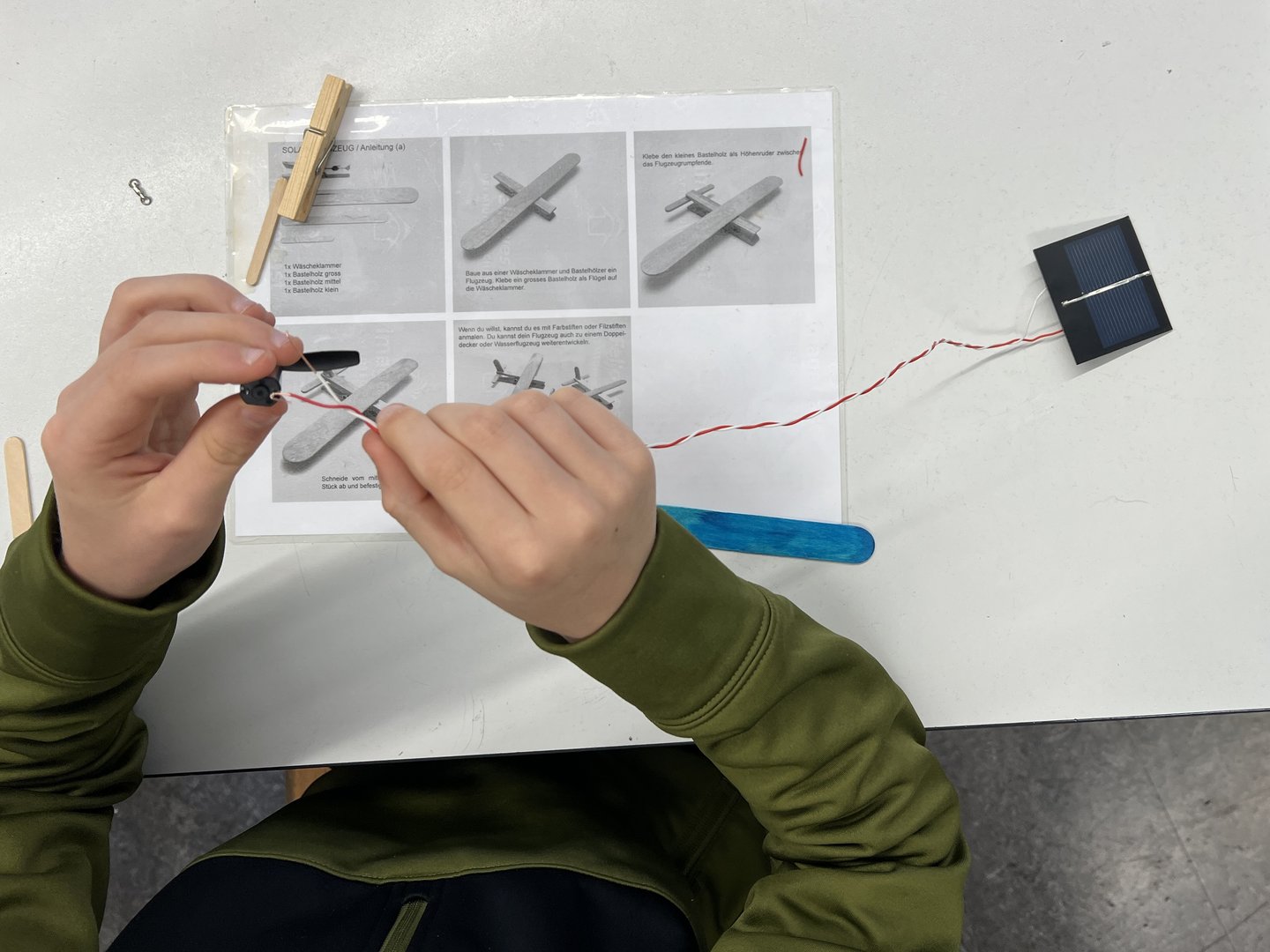
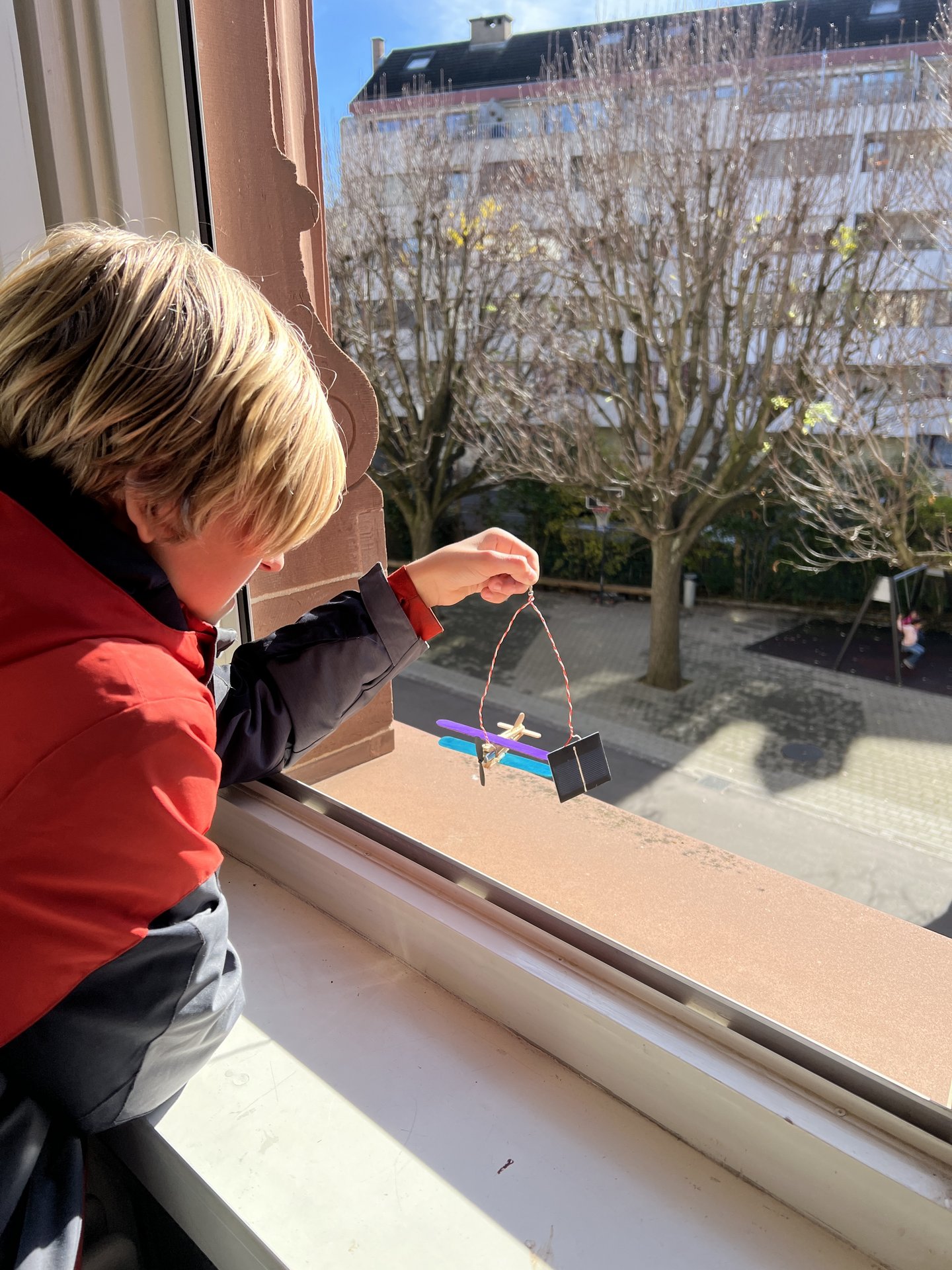
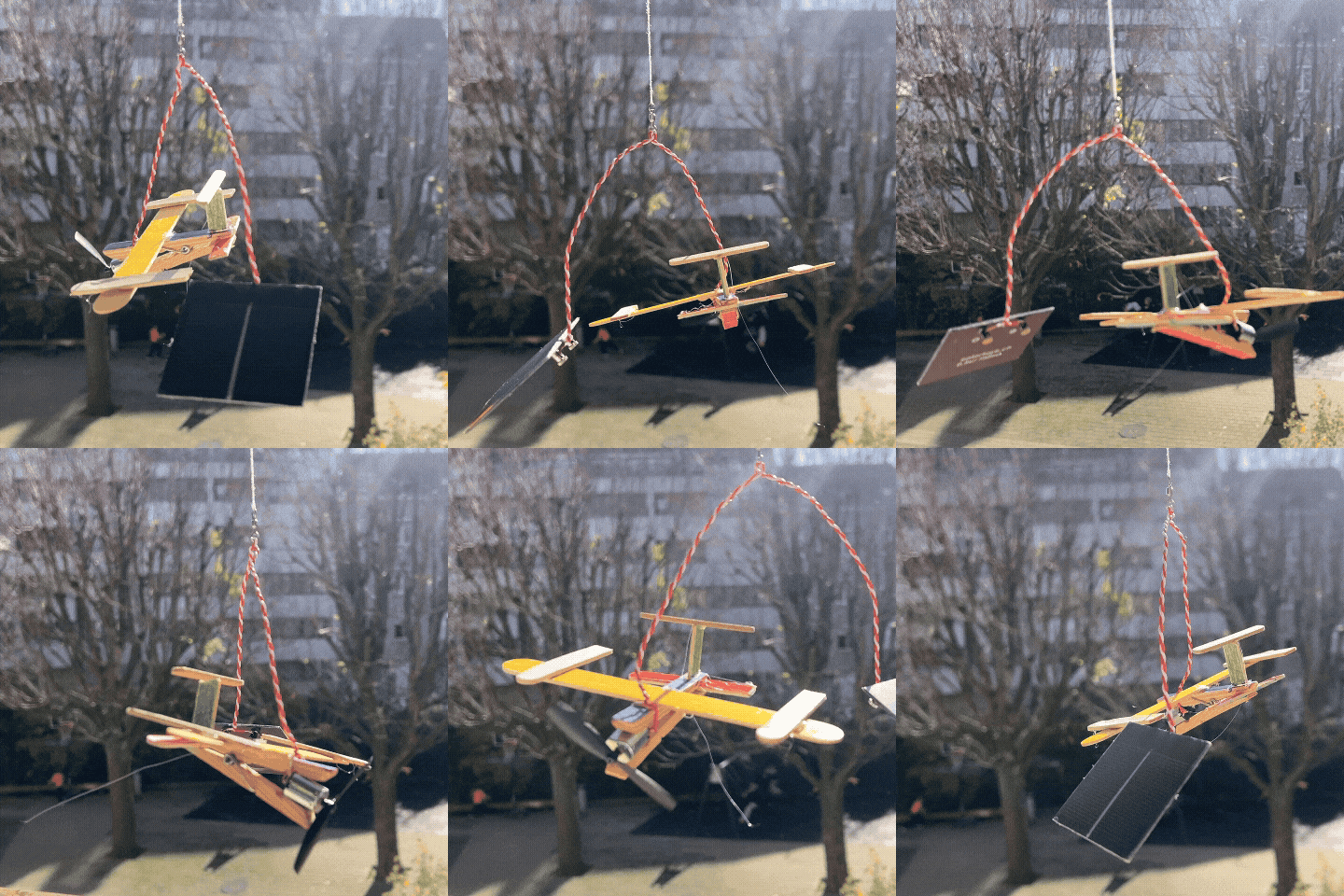
Using Google Earth, we explore large solar power plants and how they look. On a swisstopo map, we discover that our school roof is rated “very suitable” for a photovoltaic installation, with an estimated annual yield of around CHF 17,240. After comparing the output of large photovoltaic systems in Basel (Grosspeter Tower, Messe Basel, St. Jakob Park, and Multiterminal 4 in the Rhine Port) with that of the run-of-river power plants at Riehenteich and Birsfelden, we build our own small PV device. The miniature airplane we construct can already fly in circles under diffuse light – meaning it works even without direct sunlight.We then learn about the structure and function of a solar cell: what materials it is made of, where the raw materials come from, and how electrical energy is generated through photovoltaics (from the Greek phōs = light and volt = unit of electrical voltage).
The Power of the Sun in Action
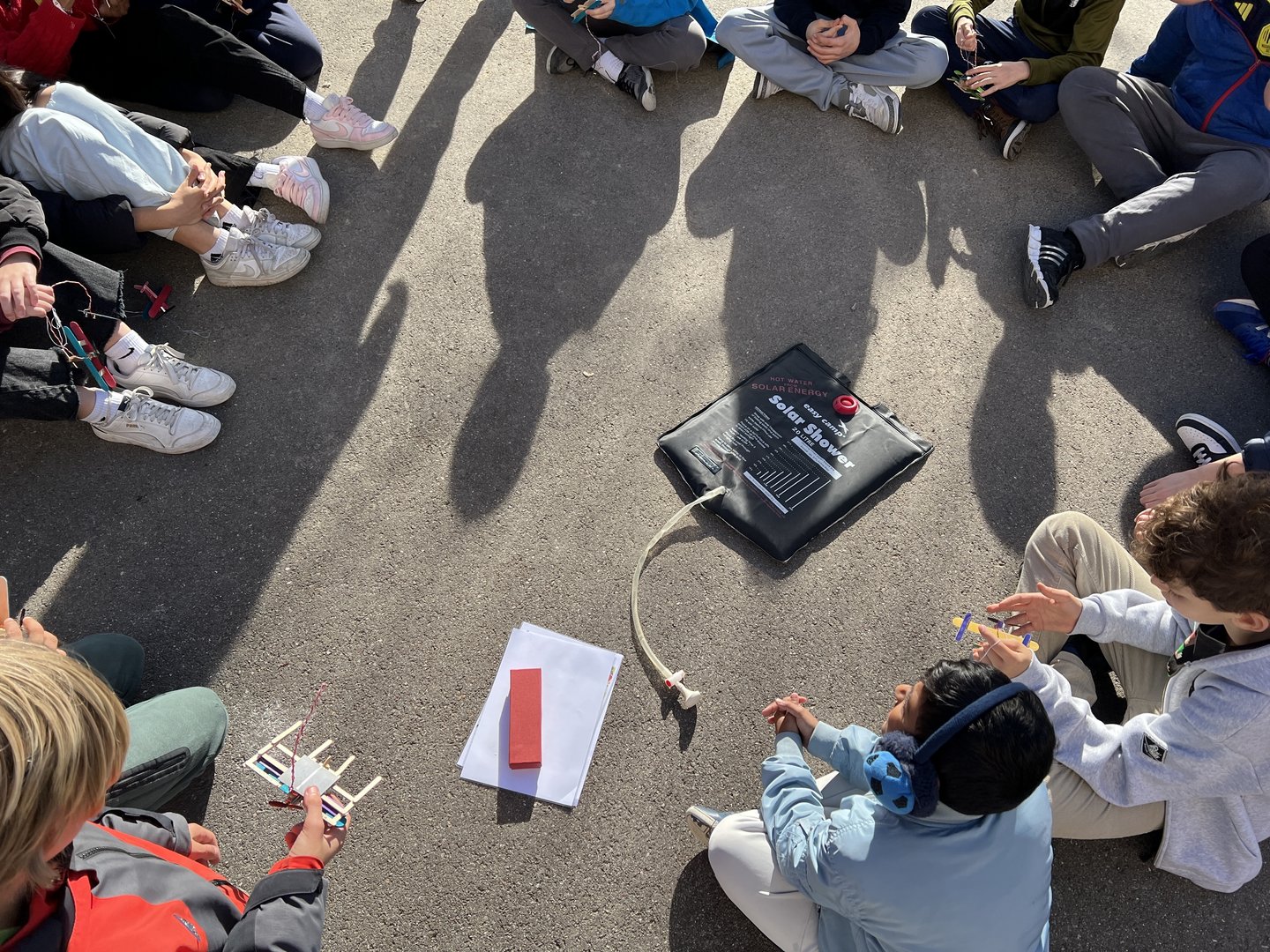
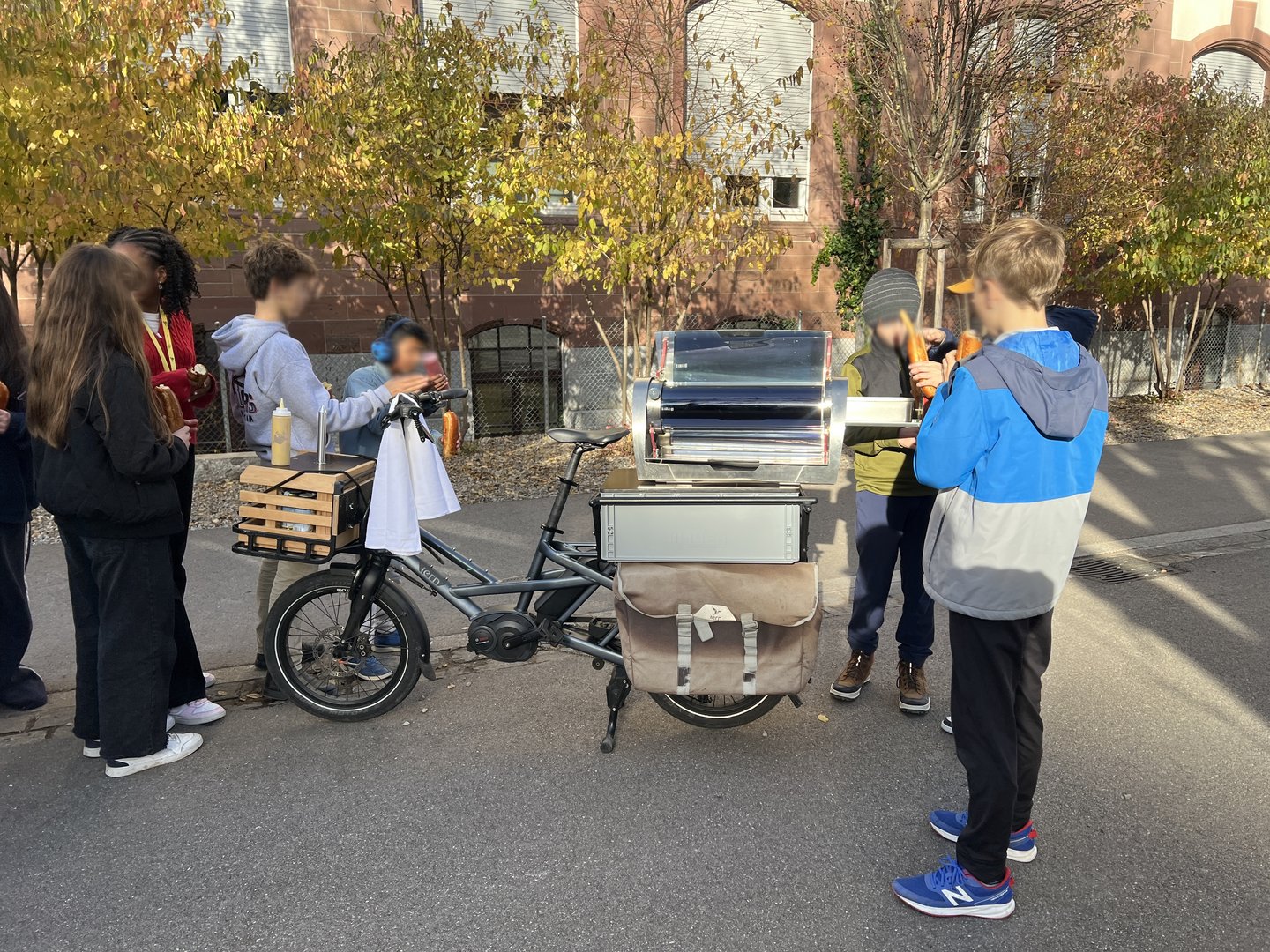
In the afternoon, lessons take place outdoors. Fortunately, the sky is almost cloudless, because solar thermal energy, unlike photovoltaics, requires direct sunlight. With magnifying glasses and a parabolic mirror, we focus sunlight until a newspaper catches fire. Equipped with hand mirrors, the whole class again imitates Planta Solar 20, making a balloon pop using nothing but sunlight. A real solar-thermal power plant works much like a conventional steam power plant – except that concentrated sunlight replaces fossil fuels. At the top of the tower, temperatures can exceed 1,000°C. Molten salts act as heat carriers, storing energy and allowing operation even after sunset. Parabolic trough power plants reach slightly lower temperatures. Curved mirrors focus incoming sunlight along a focal line. We even mounted such a tube collector with mirror onto an e-bike as a mobile hotdog steamer! To finish, everyone enjoys a warm sausage or vegetarian option in a bun – of course, heated by the power of the Sun.





An Event by
Nomatark
Date & Location
November 4, 2025, 10:30–15:00 (5 lessons)
Swiss International School Basel
Participants
17 students from class P6E1
Teacher
Katharina Heppeler
Guide
Fabian Müller
Feedback
«Thank you for the wonderful day. You’re a very good teacher! Daily rating: ★★★★★»
«The thing with the airplane was really cool. You explained it very well.»
Jonas, 12 years old
«I love the hotdogs and the airplane is beautiful.»
Emmanuel, 11 years old
«I was really happy to eat a hotdog. But the best thing of all was building the airplane. I really enjoyed it.»
Jan, 11 years old
«I had so much fun! For me, the hotdogs were the best! Building the airplane was also fun! Thank you!»
Rika, 12 years old
«The hotdogs were very tasty, and I liked the vegan sausages. I think you shouldn’t change anything, because I enjoyed it so much.»
Henri, 12 years old
«Everything was great, but next time you could also make hotdogs with chicken.»
Sarp, 11 years old
«It was really cool. Thank you for taking the time for us.»
Julia, 11 years old
«Thank you for telling us about atoms, solar cells, and more. I don’t know what you could do better. Thank you very much for the hotdogs.”
«Thank you for the wonderful day.»
Arthur, 11 years old



The power of the Sun
17
11.4 kg
1
4.8 h
3.4 km
0.36 kWh
Berechnungsweise
Folgenden Formeln verwendet unser Veranstaltungs-Counter
Berechnung PV-Strom in kWh:
Eine Wattstunde entspricht der Energie, welche ein System (z. B. Maschine, Mensch, Glühlampe) mit einer Leistung von einem Watt in einer Stunde aufnimmt oder abgibt. Im Alltag gebräuchlich und verbreitet ist die Kilowattstunde (kWh), das Tausendfache der Wattstunde.
Unsere mobilen Solarkraftwerke sind mit jeweils drei PV-Modulen à 54 W ausgerüstet. Je nach Veranstaltung, Energiebedarf und Technik werden bis zu vier Solaranhänger eingesetzt. Wir zählen die Anzahl eingesetzter Solarkraftwerke und die Sonnenstunden.
Wh = Anzahl Solar-Anhänger • 150 W • Sonnenstunden
kWh = Anzahl Solar-Anhänger • 150 W • Sonnenstunden ÷ 1'000
CO₂-Äquivalente:
Bei der Verbrennung eines Liters Benzin (0.74 kg) bilden sich ca. 2.32 kg CO2 (und Wasserdampf). Dazu werden rund 10.4 kg bzw. 10‘000 Liter Luft benötigt. Bei einem Sauerstoffanteil von 21% sind dies ca. 2.2 kg Sauerstoff.
Die Treibhausgase entstehen aber nicht erst bei der Verbrennung im Motor der Fahrzeuge (Auspuff-Emissionen). Förderung, Transport, Raffinerie, Feinverteilung und Infrastrbauten wie Tankstellen oder Popeline veruraschen ebenfalls Emissionen. Die Treibhausgasemissionen der Bereitstellung von Benzin betragen rund 0.461 kg CO2 bzw. 0.76 kg CO2-eq pro Liter Benzin.
CO₂-Äquivalente (CO2-eq ) sind eine Masseinheit zur Vereinheitlichung der Klimawirkung der unterschiedlichen Treibhausgase. Neben dem wichtigsten von Menschen verursachten Treibhausgas Kohlendioxid (CO2) gibt es weitere Treibhausgase wie beispielsweise Methan oder Lachgas. Die verschiedenen Gase tragen nicht in gleichem Masse zum Treibhauseffekt bei und verbleiben über unterschiedlich lange Zeiträume in der Atmosphäre. Um die Wirkung verschiedener Treibhausgase vergleichbar zu machen, hat das Expertengremium der Vereinten Nationen (Intergovernmental Panel on Climate Change, IPCC) das so genannte «Globale Erwärmungspotenzial» (Global Warming Potential) definiert. Dieser Index drückt die Erwärmungswirkung einer bestimmten Menge eines Treibhausgases über einen festgelegten Zeitraum (meist 100 Jahre) im Vergleich zu derjenigen von CO2 aus. So hat z.B. Methan eine 28× grössere Klimawirkung als CO2, bleibt aber weniger lange in der Atmosphäre. Die Klimawirkung von Lachgas übersteigt die von CO2 sogar um beinahe das 300fache. Treibhausgasemissionen können in CO2-Äquivalente umgerechnet und zusammengefasst werden. CO2-Äquivalente werden mit der Abkürzung «CO2-eq» bezeichnet.
Berechnungsgrundlage eingesparte Treibhausgase:
Nomatark produziert – von der Atmung abgesehen – sowohl beim Transport als auch bei der Aufbereitung des Stroms kein Kohlenstoffdioxid. Als Reverenz für das eingespahrte CO2 nutzen wir den CO2-Ausstoss eines durchschnittlichen benzinbetriebenen Pkw addiert mit den Abgasen eines, für die Stromerzeugung handelsüblichen, benzinbetriebenen Stromaggregats minus der CO₂-Äquivalente von Photovoltaikanlagen pro kWh. Aus dem Auspuff des Generators kämen, vom CO2 abgesehen, noch Kleinstmengen (Mikrogramm) weiterer Treibhausgase wie N2O und CH4 (viel weniger als 1 Promill THGE). Diese Treibhausgase werden in unserer Berechnung nicht berücksichtigt.
Wir nutzen unsere mobilen Solarkraftwerke auch als Transportmittel für die Technik. Drei unserer Fahrradanhänger entsprechen dem Ladevolumen von einem Pkw.
Referenzwerte für Treibhausgase:
CO2-eq Benzin: 3.08 kg/L
CO2-eq Pkw: 1.9764 kg/km
CO2-eq E-Bike: 0.1527 kg/km
CO2-eq PV: 42 g/kWh
Benzinverbrauch Generator: 1.3 L/h
Formel für Treibhausgase:
CO2-eq Einsparung durch Transport in kg: Distanz in km • (Anzahl Pkw • CO2e Pkw - Anzahl E-Bike • CO2e E-Bike) = km • (Anzahl Pkw • 1.9764 - Anzahl E-Bike • 0.1527)
CO2-eq Einsparung durch PV in kg: Sonnenstunden • 1.3 • 3.08 - 42 g/kWh
Berechnung km:
Hin- und Rückweg ab unserem Atelier an der Kleinhüningerstrasse 205 in Basel-Stadt. Der Fahrtweg wird via Google Maps eruiert. Egal wie viele Fahrräder und Fahrer:innen eingesetzt werden, als Fahrtweg zählt nur die Strecke zwischen Lager und Veranstaltungsort. Zusätzliche Fahrten (Einkäufe und Personentransporte) vor und während der Veranstaltung werden nicht berücksichtigt.
Anzahl Anlässe:
Jeder Veranstaltungstag wird einzeln gezählt. Mehrtägige Events werden als mehrere Anlässe gewertet. Workshops an Schulen werden pro Klasse gezählt.
Quellen:
IPCC 2021 Sixth Assessment Report
Rolf Frischknecht, treeze Ltd.
CO2-Äquivalente PV: Ökobilanz Strom aus Photovoltaikanlagen, Factsheet v1.0, Update 2020, treeze Ltd.
Umweltbilanzierung von Verkehrsmitteln: Matthias, Tuchschmidt, Halder, Markus (Hrsg.): mobitool Grundlagebericht. Bern: Schweizerische Bundesbahnen, SBB 2010.
Benzinverbrauch Generator: Stromagregat Berlan BSTE, 4-Takt Benzin, 2'500 W